-

NEWS
BETOBA ELECTRIC POWER TECHNOLOGY
NEWS INFORMATION
News dynamics
Advantages of Using Busway Systems
With the development of the socio‑economic landscape and advances in science and technology across all sectors, social infrastructure and equipment are proliferating, and electricity consumption continues to rise. In particular, the growing number of workshops and factories has outpaced the capacity of the power supply, creating significant challenges for engineering projects and industrial facility construction.

04
2024
Application Scope and Service Life of Busway Systems
Busway systems are power distribution solutions designed for modern buildings and large industrial facilities that require substantial electrical capacity. As technology advances and times evolve, the demand for electricity in contemporary life continues to grow. For certain factories with high power consumption, the capacity of conventional utility grids often falls short. The advent of busway‑based power distribution systems provides a straightforward solution to this challenge, ensuring that large industrial plants can operate smoothly without being constrained by inadequate power supply.
04
2024
Cooling methods for compact busbar trunking systems
If the temperature of a busbar trunking system becomes too high, common failures may occur. For safety, it is essential to take steps to keep the busbar trunking temperature within safe limits, thereby preventing overheating that could damage the system.
04
2024
Cooling method of compact busbar trunking systems
If the temperature of a compact busbar trunking system becomes excessively high, common faults may occur. To ensure greater safety, it is essential to understand the cooling method employed by the compact busbar trunking system and take measures to prevent overheating from damaging the equipment.
04
2024
Closed-type busbar trunking systems offer the following advantages:
Different insulation materials: In gas‑insulated busbars, there is a deliberate gap between the grounding copper bars, meaning that the insulation at the core of the grounding bar is based on gas. By contrast, in enclosed busbars—also referred to as closed‑type busbars in many regions—the insulating material between the conductors is typically a chemically synthesized insulator. Oil‑immersed transformers and enclosed busbars are collectively referred to as busbars. Both “enclosed busbar” and “busbar” denote the same device.
04
2024
Characteristics of Closed Busbars
Closed‑type busbars are widely used. Their selection and application offer a high safety margin and ensure excellent insulation performance. They are a new, environmentally friendly material with the following characteristics.
04
2024
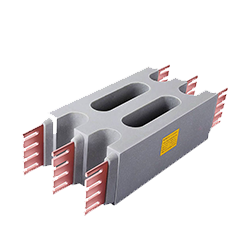
This product was introduced to China from Europe and has a history of over 40 years in practical application. It fully leverages the unique physical properties of volcanic rock‑derived silicon minerals—such as insulation, flame retardancy, high‑temperature resistance, fire protection, water resistance, breathability, and weatherability—thereby fundamentally addressing not only the short‑circuit risks inherent in first‑generation busbar phase conductors, but also the issues of low insulation and ingress protection ratings, as well as numerous potential leakage points at joints, that plagued second‑generation busbars.
04
2024
10 kV volcanic rock silicon mineral fully cast busbar in power operation
As power infrastructure construction advances, the demand for installing electrical equipment in harsh environments is increasing. To ensure stable power supply under such conditions—particularly in salt‑spray‑prone coastal areas or corrosive chemical plants—it is often necessary to employ fully cast busbars made from volcanic‑silica mineral materials with a high degree of protection.
04
2024
Materials used in fully insulated busbars
Fully insulated busbars use epoxy resin as the insulating material, which boasts exceptionally excellent insulation properties and can withstand voltages exceeding 50,000 V. Epoxy resin, as an insulating material, offers distinct advantages such as superior dielectric performance, high mechanical strength, and excellent sealing and cost-effectiveness. The sections of a fully insulated cast‑in‑place busbar are spaced apart, including the resin‑cast tee joints. Even if the conductors within the fully insulated busbar have burrs, these will not compromise the resin insulation or cause a short circuit. Moreover, since the fully insulated cast‑in‑place busbar lacks an external enclosure, the risk of inter‑section short circuits is virtually eliminated.
04
2024
SUBSCRIPTION INFORMATION
Product Categories
Contact Us
Address: No. 735, Xinling Road, Shiqi, Panyu District, Guangzhou City, Guangdong Province


WeChat Official Account
Copyright © 2024 Betoba (Guangdong) Electric Power Technology Co., Ltd. All Rights Reserved. Power:www.300.cn SEO license