-
What does “closed busway” mean?
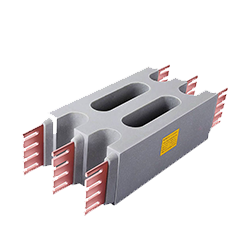
There are two types of enclosed busways. One type has a high current‑carrying capacity but cannot withstand high temperatures; it operates only up to 200°C and is typically installed on power distribution circuits. This type is also referred to as a clustered enclosed busway. The other type is heat‑resistant, capable of maintaining electrical transmission for 1.5 hours under operating temperatures ranging from 700°C to 1,000°C, with a current‑carrying capacity of up to 5,000 A. This type is known as a fire‑proof enclosed busway. The key difference between the fire‑proof enclosed busway and the clustered enclosed busway lies in their enclosures: the fire‑proof version is coated with a fire‑retardant industrial paint, whereas the clustered version features an electrostatic powder coating that provides a smooth finish and strong adhesion of the corrosion‑resistant layer. Therefore, when selecting a busway for safety‑critical fire‑protection circuits or EPS/EPS emergency power supply systems, a fire‑proof enclosed busway should be chosen.
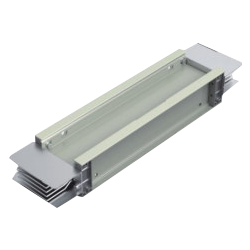
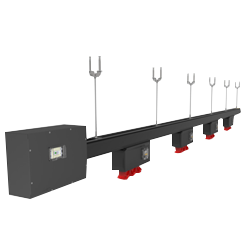
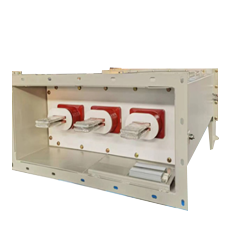
Closed‑type busway is commonly referred to as a busway; in other words, the closed‑type busway is essentially the “undershirt” of the busway, while the busway can be seen as the “undershirt” of the closed‑type busway. Both terms refer to the same device. A closed‑type busway is a busway system constructed from metal sheet material—carbon steel or aluminum—designed to enclose and protect the enclosure, conductive busbars, insulating materials, and associated components. It can be configured with junction boxes at regular intervals, or it can be manufactured as an explosion‑proof enclosed busway without intermediate junction boxes.
Different insulation materials: In gas‑insulated busbars, there is an appropriate gap between the grounding copper bars, meaning that the insulation at the core of the grounding bar is primarily gas‑based. By contrast, in enclosed busbars—also referred to as closed‑type busbars in many regions—the insulating material between the busbars is a chemically synthesized insulator.
Minhang District’s oil-immersed transformer recycling and closed‑type busbar trunking systems are collectively referred to as busbar trunking. The terms “closed‑type busbar trunking” and “busbar trunking” denote the same product. A closed‑type busbar trunking is a busbar system constructed from metal sheet materials—carbon steel or aluminum—designed to enclose and protect the enclosure, conductive paths, insulating materials, and associated components. It can be manufactured either as a tapped closed busbar with junction boxes at regular intervals, or as an explosion‑proof closed busbar without intermediate junction boxes. In the intelligent management systems of power supply and distribution in high‑rise buildings, the main trunk lines play an especially critical role—much like the pulmonary artery in the human body; any obstruction can lead to serious consequences. Consequently, manufacturers, installers, and research institutions have been striving to enhance the reliability of these main trunk lines, resulting in new materials that are easy to install, cost‑effective, and offer stable performance.
What is a busbar trunking system? A busbar trunking system is a closed‑type, metal‑encased industrial device composed of copper or aluminum busbars, used to distribute power and serve high‑capacity applications. It is an efficient substation component, offering cost‑effective power distribution for high‑rise buildings as well as small, medium, and large manufacturing facilities. As energy losses continue to rise across various industries, traditional cables can no longer meet the demands of high‑current transmission and distribution systems. The parallel routing and installation of multiple cables often make on‑site assembly and construction connections increasingly challenging. As a modern substation‑level power distribution solution, busbar trunking systems incorporate advanced technologies, materials, and manufacturing processes, significantly reducing electrical contact resistance and heat generation at the interfaces between busbars and mounting points. The use of high‑quality insulating materials further enhances safety and reliability.
SUBSCRIPTION INFORMATION
Product Categories
Contact Us
Address: No. 735, Xinling Road, Shiqi, Panyu District, Guangzhou City, Guangdong Province


WeChat Official Account
Copyright © 2024 Betoba (Guangdong) Electric Power Technology Co., Ltd. All Rights Reserved. Power:www.300.cn SEO license